Search This Blog

Thursday, May 15, 2014

The Hannibal Lecter series by Thomas Harris

   
When I say "Hannibal series" I mean Hannibal Rising, Red Dragon, Silence of the Lambs, and Hannibal. Each deal with the the famous literary serial killer Hannibal "the Cannibal" Lecter, who was a respected psychologist and doctor before he was discovered to be killing and eating people. Hannibal Rising describes his childhood and how he developed into a killer; Red Dragon describes after he was captured and focuses on a case he consults the FBI on; Silence of the Lambs is where Lecter meets young FBI Clarice Starling, who is trying to capture another serial killer, Buffalo Bill; finally, Hannibal revolves around Clarice and Lecter, and how they interact post-Buffalo Bill. Undoubtedly Hannibal is my favorite because Clarice is out of her awkward newbie stage and it is the first Lecter novel which is all about him as an adult. Readers learn more about his manipulation methods and perspective.


Hannibal's an anti-hero, meaning that readers shouldn't sympathize with him, but he's so charming and intelligent that a part of us wants him to be free; it also helps that he mainly eats rude douchebags who, some think, deserve to die. One example is Mason Verger, who was a client of Hannibal's because he was caught molesting children. Serial killers are fascinating to me to begin with, and Harris does a good job of not making it just about Hannibal's doings, but also some cases; it propels the plot at a good rate, and keeps readers preoccupied while Hannibal does things behind the scenes that we are distracted from.

Just a snack...
I don't completely follow Dr. Lecter's fascination with Clarice Starling because she isn't someone that pairs well with sophisticated Hannibal- I don't believe he likes her more than he likes toying with a supposedly incorruptible FBI agent.

Starling would totally think these would be acceptable to wear.
A warning: These are some of the more crude novels I've ever read. Harris doesn't shy away from making his evil characters as evil as possible, and nothing is off limits, including children, graphic gore scenes, sex references from anywhere on the spectrum, so be careful. Past that, Harris certainly does his research on criminology, gives deeply puzzling characters, and flips your sense of morality on its head.


A word on the movies: Anthony Hopkins as Hannibal Lecter was the best casting decision ever made. Mads Mikkelsen does well in the TV series, but he can't fill Hopkins' shoes quite the same way. I enjoyed Julianne Moore (Hannibal) as Clarice Starling more than Jodie Foster (Silence of the Lambs) because Foster just comes across as dumb and cheap, though she has an excellent panicked voice. Ralph Fiennes was a scary serial killer in Red Dragon, and Edward Norton was just plain adorable. In conclusion, I would recommend you see all the movies and the TV episodes, and read all the books; Harris definitely deserves the royalties.

READ THEM.


Wednesday, May 14, 2014

The Red Tent by Anita Diamant


This was a very magical book- those who like Alice Hoffman will love Diamant's rendition of Old Testament women. Those unfamiliar with the story of Jacob definitely want to at least Sparknotes that part of Genesis before picking this up. The Red Tent is a feminine power book with a unique spin on the story of Jacob and his wives, mainly Rachel and Leah; it also addresses the religion of the wives pre-Jacob and life within their world.

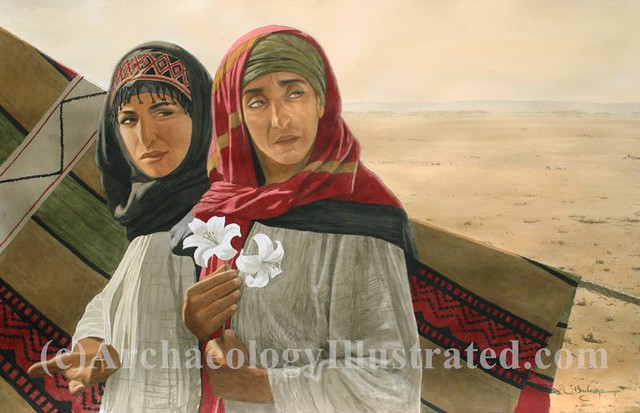
The women might have looked like this
The development of their father Laban and their mother added the background one wishes for when reading about these Jewish matriarchs. Those who can't read gory stuff or may visualize what's going on in books should be careful when reading this book. It's a girls' book, and we deal with periods and childbirth and midwifery and such. It also gives creative interpretation of why Rachel backed out of marrying Jacob at the last minute at their first wedding; those who imagined it was because the elder Leah should have gone first would not be wrong, but Diamant shows it may have been more than that.

This chart may help you with all the names.
Finally, and in my opinion the best part, the story develops the Rape of Dinah. In Genesis Chapter 34, Jacob's daughter Dinah goes to the nearby town of Shechem and is seduced by the prince. He then goes to Jacob and promises to marry her and convert he and his people to Judaism. However, Dinah's brothers took her seduction as an insult (“Should our sister be treated like a whore?”) and they slay the town of Shechem while the men lay in pain from circumcision.


It is interesting that readers never hear the story from Dinah's POV; indeed, we are never given her opinion of the event, and her mother and aunts are likewise silent. Why? Who wrote this story and what was the purpose of it? Diamant's novel seeks to portray some possible answers to these questions.

Medieval interpretation by Giuliano Bugiardini
I read this book before I took a classes on women of the Old Testament and the Book of Genesis, so I had problems separating the fictitious book from the biblical literature. However, I feel this shows the skill in Diamant's leadership; she picked details from scripture and commentary to build these images of women who began multiple religions, and made them more lifelike to modern readers.

Thursday, May 1, 2014

A Great and Terrible Beauty by Libba Bray

3682

This is another Young Adult lit book where the heroine, essentially orphaned, finds out she has magical powers and hidden enemies. However, it's not just another YAL book of this overly-used plot.

Gemma Doyle, born in England but raised in India by her parents, witnesses her mother's murder when she's 16. She's shipped back to England to meet her depressed and now opiate-addicted father and sycophantic brother. However, she doesn't even stay with them for a night; a waiting carriage takes her to Spence Girls' Academy where, in true Victorian fashion, girls are taught proper etiquette, dress, household management, and entertaining skills. Along with the usual fitting-in issues young girls have, Gemma now has to reconcile her mother's death and these strange visions that keep ruing her day.
Ugh, imagine doing this day in and day out.
Aside from my appreciation of the detailed historical research Bray has done on Victorian England, I like that she also shows restraint on the telling of the story. This is book one of a trilogy, and Gemma Doyle is an international girl of the Empire; the author could have easily made the series about conspiracies with the government or military. Because of her focus, she's able to deal with more individual issues. Homosexuality, drug addiction, abuse, racism, class issues, immigrant sensitivity, and other adolescent worldly copings are handled appropriately by Bray. Her mother's death and suicides within the girls' school also give ways to handle loss in a teen reader's life. Then, add magic planes of existence and nightmares that aren't so much personal but supernatural!
Unfortunately, it's not this kind of pretty magic.
However, many wouldn't like these books for these reasons. Should a YAL book exemplify behavior on these controversial issues? It that what separates YAL from adult fiction? I'd love to hear your reactions!

Wednesday, April 30, 2014

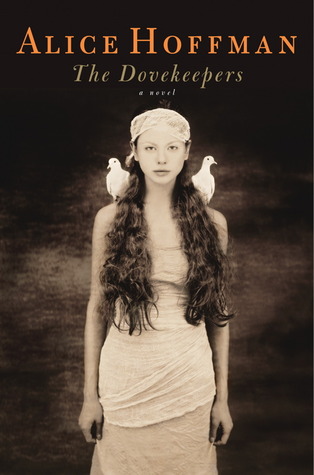
The Dovekeepers by Alice Hoffman

10950924

This book was absolutely fantastic, and I look forward to rereading it. It gives a firsthand account of  Masada, a palace held by the Jews after the destruction of the Second Temple, which was laid siege to by Romans. The POV switches between 4 women, all dovekeepers, who come to Masada for a safe place to live and deal with their own personal issues, including surprise pregnancies, abandonment, sisterhood, and what it means to be a warrior. 

This is likely how Masada looked in 70 CE.
If I were a hashtag person, the top three which would describe this book are #femininity, #defense, and #stories. These 4 women are dealing with the events which most impacted their lives. Despite death, poverty,  losing their men to war, and the destruction of their most sacred place, these women redefine strength and sacrifice. 
The women likely dressed like this.
As I've probably said before, I love female empowerment stories. This doesn't mean I like men being put down or made fun of, but more I enjoy books which appreciate the hardships women endure, especially women from the past. Their secretive schemes in a male-dominated society include witchcraft, warfare, and Jewish worship in unique tones. The religious studies aspect of my brain was well-satisfied with the practices which were described in the book; Hoffman definitely did her research.
 
For example, this is a mikveh, a small pool women dipped into to purify themselves after committing a sin or menstruation. 
Their resourcefulness was inspiring, and so was their love for each other and their families. The POV switch wasn't confusing, and the book would make a wonderful miniseries. There was enough twists to keep me interested, and I fell in love with the characters. Hoffman's other books were also of this high caliber, and I appreciate that she's kept up the quality. 

Rebecca by Daphne du Maurier

http://literaryminded.files.wordpress.com/2011/11/rebecca11.jpg

This was a very clever book! I read it for an English lit class on English country houses (think Downton Abbey), which was a lot more boring than it sounded. It starts out with a young woman meeting rich Mr. de Winter in Monaco. She isn't wealthy; in fact, she's someone else's servant. Somehow he falls in love with her and they get married. He whisks her off to his rich estate in England, called Manderly. It's supposedly the most beautiful country house there is, but the new Mrs. de Winter is having problems settling in. It seems there was a first Mrs. de Winter, Rebecca, who everyone loved for her grand parties and smart sociability. However, she died in a tragic accident some time ago. When one of her friends comes and points an accusatory finger at Mr. de Winter, his new wife must decide if she should stand by her new man, or save her own skin. And who is behind all the accusations? Is Rebecca still a player in the game she has made of their lives?
http://spoki.tvnet.lv/upload2/articles/66/666285/images/_origin_spocigie-stasti-2.jpeg
Could this be her?
 This a mystery that starts out as a romance novel, but not a bodice ripper (though the cover looks like it), One of the best things about this book is that du Maurier never gives the name of the narrator- we also never know if it's a ghost story or the narrator is just slightly unhinged. Because of the love she has for Mr. de Winter, the second Mrs. de Winter isn't entirely a trustworthy narrator.

Like any good mystery the book has plenty of twists down to the end, which did not disappoint. In case you haven't guessed, I place a lot of emphasis on a well-thought out ending. There's also a movie, but I haven't seen it because they aparently really messed up the ending.

The setting, which encompasses much of the mystery, is a beautiful but scary place. It's kind of like that relative's house that is always so perfect; you want to see it but are so afraid to touch it because you could have some invisible dirt that transfers. Therefore, the mansion becomes the Pandora's box of all the shit between Rebecca and Mr. de Winter. The final question becomes: do you trust his version of events?

Sex with Kings & Sex with the Queen by Eleanor Herman

 http://chroniclesoftimes.com/wp-content/uploads/2012/07/sex-with-kings.jpghttp://photo.goodreads.com/books/1166719842l/16179.jpg

There is no form of historical biography more fun than the sordid exploits of monarchs. There's something very American in books like Herman's; we publish the gross details and failings of our leaders, and, in doing so, flip the bird at the former rulers of the world. Herman reads contemporary sources (some of which I suspect have the credibility of some tabloids) and includes as much craziness as possible. Some figures, like Cleopatra, continue to fascinate because of her exotic origins and opulence.

http://www.todayinliterature.com/newsletters/2005-03/15/cleo&julio.jpg
She had herself rolled up in a rug and delivered to Julius Cesaer. She might have been a little overeager...
 Aside from the cliches like Henry VIII and Anne Boleyn (who was found guilty of doing her brother) or Catherine the Great (who supposedly copulated with war horses), some lesser known examples are just as crazy. For example, one Portuguese king, obsessed with producing an heir from his wife though he was impotent, made a golden turkey baster and inseminated his wife successfully.

 http://www.ohthethingsmommiesdoblog.com/resources/turkey-baster.jpg

Even for readers who don't go outside the boundaries of fiction very often, these books give enough giggles to make them quick reads.

Goodreads link to Book #1 and Book #2

Tuesday, April 29, 2014

The Secret Life of Bees by Sue Monk Kidd

I've loved Sue Monk Kidd since I read her Dance of the Dissident Daughter, so I figured I would love this one too. Whether I would or not, I had to read it for American Film and Lit class. Usually assigned books go over with me like a Kevin Smith movie (gag), but this ended up being the first book in a long time that I read in one day.


This story relates Lily Owens' journey to understand her mother, who died when she was a baby. After running from her abusive father with her black housemaid; because it's in the middle of South Carolina during the Civil Rights Movement, there's considerable danger to her friend. From a label which was one of her mother's few positions, Lily tracks down the Boatwright sisters who bottle their own honey and play host to the Daughters of Mary; this was a sect of black women who put a spin on Christianity to make it more feminine and relatable. Lily's trial to find home and her mother within herself takes readers on an emotional journey that ends satisfyingly and with a heart-warming hope for the future.

Personally, I could relate to the heroine's rough childhood, though I never had to kneel on grits. The dad I hated for obvious reasons, but I also understood his anger towards his daughter. I didn't agree with it, but I understood it. I loved the female-centric religion; I've always thought Jesus and his family was black :-)

Black Madonnas are more common than most people think.
But here's the best thing about Kidd's work: subtle magic. Almost in a Practical Magic and Sarah Addison Allen way, her stories aren't blatantly supernatural but she addresses social issues (like child abuse and racial tension) and the uses "magic" to solve them. For example, the sister with a big pole up her ass must use the most powerful magic to heal her family after a terrible tragedy: love. That is the cheesiest example I could come up with, but ultimately true.

Also, by writing through a child's POV, who can't distinguish race like other southerners and therefore comes down on the right side of the Civil Rights Movement, Kidd was able to acclimate her reader to the pagan practices of the Daughters of Mary. Also, the bees were an unusual element- we know of bees, but don't know them. Kidd's skill is that, as we get to know the bees, we know the meaning of home. No shame in admitting that this book made me cry. 

Thanks, dude!
The movie was not as good as the book, but worth the time. I loved Alicia Keys and Dakota Fanning, so I safe in recommending that as well.